Saturday, 15 October 2016

Make Mountains with Your Sewing Machine

As promised in the previous post on Free Machine Embroidery here are a few snaps of the lesson on 'drawing' mountains and hills with your sewing machine.
Feed dogs down, attach the Darning (aka Hopper) foot, place your fabric backed with Iron-on-Vilene under the foot, foot down and away we go! 
 Here is our Tutor, Sue Bennet's Sample Mountain above. Firstly, colour a background with Watercolour or soft leaded pencils or crayons in greys, greens and browns; then using Straight Stitch start to 'shade' in the slopes with the darkest colour first and adding the lighter coloured threads after to form Snow or Glaciers.
Remember to tilt your work in the direction of the slopes!
 Dark looming mountains awaiting their snowy sides, above. Equally you could use this technique to form lava flowing down a volcano. Love the verdant greens of the hills in the foreground.

Tip - when covering your fabric with dense stitching it is a good idea to bring your bottom/bobbin thread; up to the top of your work. To do this simply lower your needle into the work and bring it back up again, catching the bobbin thread with a pair of tweezers. (computerised sewing machines have a needle up/down facility. Simply press the button once to take the needle down and again to raise it. It will bring the bobbin thread up with it). 
Hold onto both threads and sew a few stitches in the same place to secure them. Snip off. 
This is a good practise as it prevents the threads from tangling and snarling at the back of your work. 
Quilters often do this when quilting on a home sewing machine and will use an open eyed/self-threading needle to take the thread to the back of the work once finished, where they will knot the threads the take them into the wadding to hide them. (needle is brought out again onto back and thread pulled taught before snipping. Pulling it taught allows the thread ends to bounce back into the wadding layer and are therefore hidden). This makes for much neater work that is also more secure - no unravelling thread with this method.
 Just starting to stitch the darker parts of the slopes here. Browns can also be used not just greys (N.B. Black is a little too harsh for peaks that are in the distance).


 Another sample from Sue, above. Lovely green hills. Remember to make your hills or mountains different shapes as they would be in Nature.
Below are some more hills of Sue's in various shades of grey thread. One also has some green added - this could depict the moss on rocks, for example.
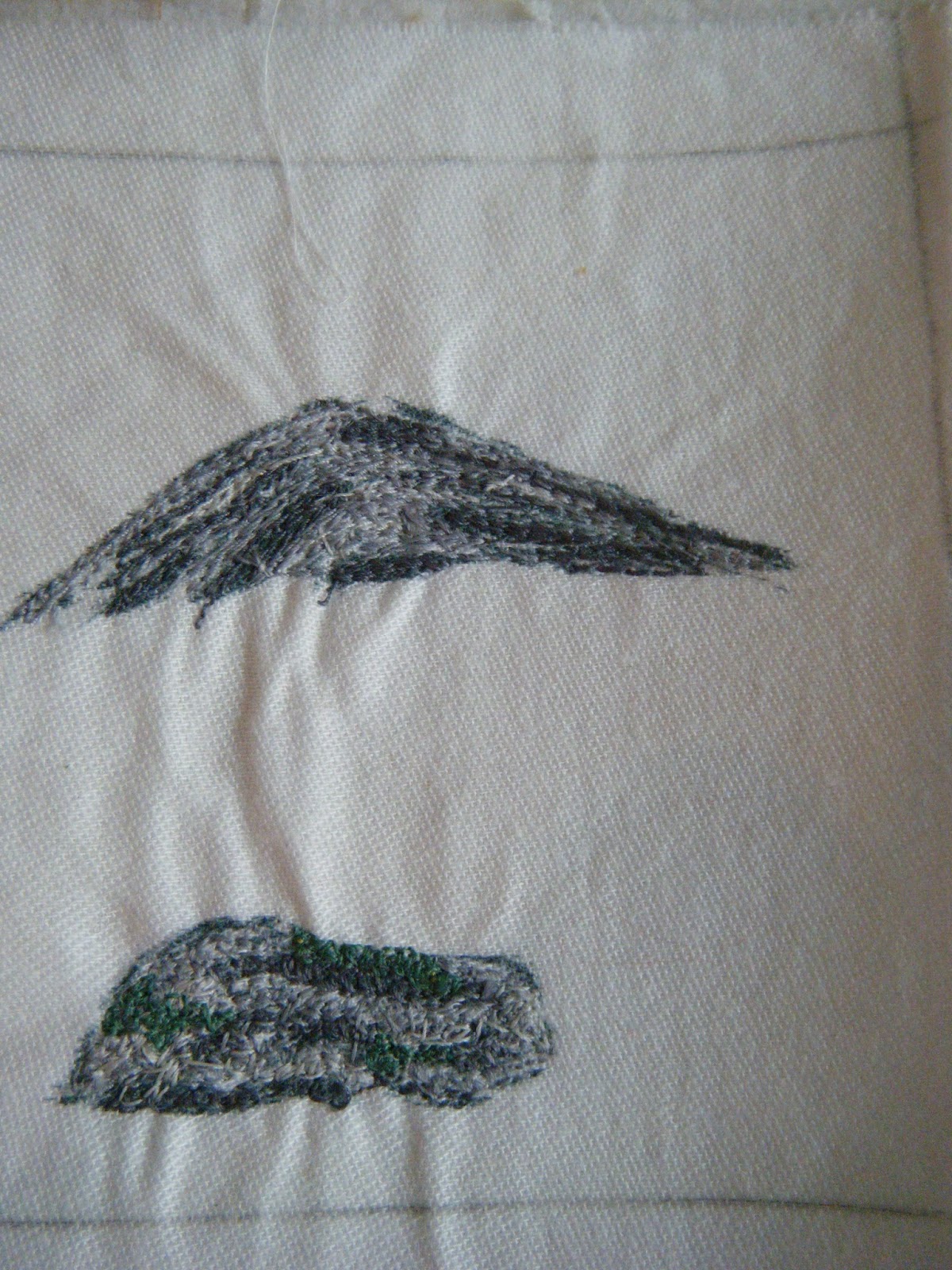

Well, that is just a little taster of what you can do with a little imagination, a Darning Foot and dropping your Feed Dogs. Not forgetting a really great Teacher! Thank you Sue.
Next up - free machined Trees.

Friday, 14 October 2016

Free Machine Embroidery

Two days ago 15 or so members of the Lytham St Annes Embroiderers Guild got together for a 6th Lesson in Free Machine Embroidery (aka free motion embroidery) where an ordinary sewing machine is used to create embroidery designs.
We met up at a local church which is a very pleasant and inspirational place to work in, not just because of the light streaming in through the windows but also due to the many colourful 'banners' or quilted posters hung all around the walls. 

Here are a couple of pics showing us at work - you don't usually get to see us as we are a little camera shy and this blog is to showcase our work and activities but these came out very well, so here goes.

Sewing makes us happy :-)


There have been several groups since that first one back in 2013; who have benefited from the knowledge and expertise of our talented long time member, Sue Bennet who devised 5 Lessons on Free Machine Embroidery. Now due to popular demand she has created a 6th Lesson to teach us how to 'draw' grass, trees, mountains and other features of a landscape; using an ordinary domestic sewing machine.
Dropping the Feed Dogs (the teeth that hold onto the fabric and help push it through the machine) and adding a Darning Foot (aka a 'hopper' foot - so called due to the hopping up and down motion it makes as you sew) allows you to move the fabric freely where you wish - hence the term 'free motion' or 'free machine'. This is also the technique used for Quilting by domestic machine.
Dividing a 12 inch square of light/plain fabric backed by Iron on Vilene to strengthen it; into 9 individual 3 1/2 inch squares
 ( separated by a 1/4 inch gap) allowed us to practise free machining different elements of a landscape to give us the confidence to create a whole picture at a future time.
Here is a quick peek at Lesson 6.

 This is our Tutor, Sue Bennet's example, above. There was quite a lot to learn and some of us got really involved trying to finish our mini landscapes which were quite labour intensive, especially the mountains (middle, top row) so most of us only did the first 3 parts. This means that poor Sue will have to set up another lesson for us! but we are looking forward to it - thank you Sue! :-) 
In order to keep each post to a decent length, this one will only feature the first mini-lesson where we learnt how to sew grass and corn.
First we added colour to the fabric using watercolour pencils. These are softer than ordinary colouring pencils and have more pigment in them. There is also the option of laying down a little colour onto paper or a palette/plate or saucer and adding water to it for a more subtle colour ( or if using Inktense Pencils adding water will enhance the colour. So beware if you have these type of pencils or blocks as the colour is really very bright and Intense (hence the name).
Grass needs to be coloured horizontally and corn is vertical to follow the natural growth pattern.

This is the example Sue sewed for us as we watched and then tried to copy.
Though the description here may describe what to do, its actually seeing the motion you need to make whilst moving your fabric under the needle and advice on the stitches to use and their length that is invaluable; so if you are having trouble and/or fancy learning this useful skill, do get in touch with us (details of our meetings etc on the right side bar) and book some lessons with Sue. She is also currently teaching the Preston Embroiderers Guild Group.
Below are a few of our efforts.
 The effect depends on how much you pull the fabric whilst sewing. In this sample above, the zig zagged grass is stretched out but in the one below it is closer together. The machinist has also changed the length of the zig zag  to give different heights of grasses.
 You can use different stitch widths and lengths to alter the appearance and try using several colours of thread. Colouring the background in several greens also added to the effect.
Corn comes in several shades too, so change the top thread now and again! Also remember nature does not grow straight up but bends and sways with the wind and grows at different rates.Here we used Straight Stitch for the corn stems and Zig Zag for the corn ears.
Look at images from magazines or books for inspiration but nothing beats having your own images, so don't forget to use the camera on your phone when you are out and about. You will find that you never look at fields in quite the same way again :-)
One last thing to bear in mind is the type of fabric you use and the vilene. You may have noticed some puckering in one or two examples shown above - this is due to the build up of stitches on the ordinary cotton fabric which is not quite up to the job. You will need to back your fabric with Medium Weight Iron-on-Vilene in every case but if you are going to cover the whole piece and work intensely on it Calico is a better option. Some also swear by Cotton Sateen which unlike calico is white and has a lovely sheen and feel to it (FYI the sheen is not too noticeable so won't interfere with the effects you are trying to make).
That's all for this post - look out for the next one showing how to stitch mountains.
Many thanks to Sue B for all her hard work, patience and enthusiasm, not just in this workshop but behind the scenes with all the lessons she has invented, planned and executed over the last 4 years. You are amazing Sue and we are so very grateful and glad to have you in our group! 

Wednesday, 3 August 2016

More from H-anne-MADE

As promised here are more lovelies created by Anne Brooke (see last post) of H-anne-MADE to look at. 
 Above is the entire (almost!) Blue wall hanging that you got a peek of in the last post with that giant bobbin holding it all up.
  Really beautiful sketchbook pages - Anne teaches classes at her studio in Brighouse and at Creative Thread in Garstang; to help people get started on their own sketchbooks and also has printed 2 very helpful booklets on the subject, available in her shop.
 Paper collaged Bird House with buttons, above and below are Coffee Cups (or maybe its tea - can you spot the tea bag tab?) and a colourful collaged Owl.

 Workshops by Anne teaching her Paper Stitched Collage technique are also available in her studio and at Garstang if you fancy having a go at this enjoyable medium; stitching by hand or machine.

Lastly a Floral piece also in paper stitched collage.

 You can see Anne at Art in the Pen, Skipton on 13 and 14 August 2016 and also at Yarndale on 24 and 25 September 2016 held at the same location.
Thank you Anne, for visiting us at Lytham St Annes Embroiderers Guild Group. We loved seeing your work and were inspired by all the  colourful and happy pieces on display. It just goes to show that stitches and embroidery can adorn many surfaces not only fabric. 
If you feel inspired by these few photos (there were far too many items to photograph them all!) why not book Anne to come to speak to your group or join on of her workshops.

Tuesday, 26 July 2016

A - Z with Anne Brooke

The speaker for our June meeting at the Lytham St Annes Embroiderers Guild was the talented, friendly and very bubbly; Anne Brooke of H-anne-MADE.
Some of you may remember her from the 2014 NW Regional Day at Rochdale. While her talk had the same title and she still has her popular signature 'seed heads' in some pieces; her work has developed into other exciting and inspirational avenues.  Take a look at some of the many she brought with her for us to view/touch etc.
 A wonderful Dandelion in a beige, brown and cream colour scheme.
Paper, maps and simple hand embroidery stitches combine to create a floral piece in calming colourways.

Meet Tallulah :-) below

Love her red hair and purple outfit.
These fascinating wooden blocks have been coloured with Koh-i-noor dyes, collaged, painted and had holes drilled into them to allow for stitching. 
 A fluffy fibrous piece inspired by nature and bursting with texture.

 The vessel above was what Anne called her 'triangular tower' and the green was more vibrant in real life but the colour got bleached out by the over head lighting. Still very lovely to look at even in this photo.
Here is a little peek of a wall hanging in a blue colourway. Have you spotted the large bobbin that is holding it up?
To see more of Anne's work 'stay tuned' for the next post :-) or if you cannot wait click here onto Anne's website or Facebook for all her latest doings (there is even a mention of the Halifax Embroiderer Guild).