Monday, 29 April 2019

Our 2018 Xmas Meal

Every year a week or two before Christmas the members of the Lytham St Annes Embroiderers Guild get together for an Xmas Meal. We usually choose a nice local hotel or restaurant but this year we went a little more 'up market' and celebrated at the local 'Big House'  Lytham Hall.
Unfortunately, due to illness I was unable to attend so only have these two snaps taken on mobile phones by a couple of kind members.
It seems like Green and Gold/Silver was the theme for the table setting.


I love the mismatched vintage crockery. 
The room looked quite large so plenty of room to walk about socialising before and after the meal. 
Here is a photo of  just one half of the room. Lovely green garlands decorate the wooden beams in the ceiling.


Quite a few familiar faces and one lovely cheesy grin :-) 
Can you spot yourself?

Thank you for the photos ladies.

Indonesian Batik

The talk in November 2018 at our Lytham St Annes Branch of the Embroiderers Guild was by Tori (Victoria) Riley, a fellow member of the Guild. 
She gave a very interesting talk and slide show about her experiences at the Batik Institute in Central Java, Indonesia.  It was all the more 'exciting' as all the lights were off apart from that of the projector - so I will not be writing too much technical detail in this post due to not being able to decipher the unfamiliar names. Writing in the dark is not the easiest task :-)

This wonderful 3 winged creature, below, is a creation of Tori's. I just loved it and was delighted to be able to purchase a postcard of him.


Here are more of Tori's designs on a pink background. Traditionally the dye is either Brown; made from a tree or Blue (Indigo) made from a leaf.


This is a bamboo Tjanting - pronounced Canting. The word Batik means Dot and is a form of decoration that uses wax to produce a pattern before dyeing the fabric. The wax acts as a resist that prevents the dye from colouring the fabric and so leaving you with your design.


Two more of Tori's Batik designs, below. I like the two birds in the corner of the smaller square.


Here is the close up of the larger batik piece, in yellow and blue underneath. 


The Sultan on the Island would dictate the patterns that the women were allowed to create. The patterns would signify rank among the courtiers.
Coastal settlements had more freedom as the patterns were influenced by trade from the visiting ships. The bird pattern called Gurdu was popular as was the criss cross called Blade.

Another yellow and blue design, below, this time more intricate. 


There are two methods of Batik - using a Stamp called a Cap ( pronounced chap) or Tulis, which is hand painted. 
Hand painting can be with a Tjanting, as we saw above, or a stick called a Rotan or with a brush as you would paint with. The wax works like gutta. 
Wax is melted in cooking pots and can be a True Wax called Gonderluem or micro wax, paraffin wax which are chemical waxes or natural wax from bees, coconuts or animals or a wax that has been used previously.
Here is a lovely piece of Batik below that has green parts to the design, which of course we know is made by mixing blue and yellow dye. This is where it all a bit of forethought is needed to decided which parts of the first dye to cover before adding the second.


Fabric used for Batik have different grades.
Primissima - a heavy cotton.
Prim - silk, satin or wool.
Biru - a very soft silk.
There are also different processes - such as the Lordan Process which has 8 stages with a different name for each; and the Bodesan Process. 

Here are some more examples from the Island of Java that are in Tori's collection. 


Exotic flowers above and the more modern looking sunshine pattern below, that we often see on sarongs and skirts in holiday resorts. What did I do with mine? I had the exact same one!

What do you think of this man/beast/snake? below....


It is uncertain where Batik originated but it is known that the Dutch took it to Africa.

A big thank you to Tori for bringing in her collection and educating us on the various techniques and processes of this gorgeous textile art.


A HOLE Load of Ideas!

No, not a typo!
HOLES was the title of the Afternoon Sewing Activity at the last NW Regional AGM. It is the latest fun idea created for us by the inspirational Sandra Kendall of the North Lonsdale Branch of  The Embroiderers Guild.
You may remember the Circles (also here4 Lines and Paisley (also here and here) activities from previous posts.

Take a look at the lovely pieces that Sandra made using a 'hole' as a starting point.


Above, some of the Holes on offer ready for some embroidery and other embellishments. Each of the fabric 'holed' pieces had been sewn together for us by Sandra so that there were no raw or fraying edges around our holes.
Wondering what that weird looking green grey stuff is in the tray, bottom left? All will be revealed later in the post...... in the meantime, here are some of Sandra's awesome ideas.


An irregular shaped hole with lace behind it and embroidery added around on the surface fabric, above, and below, a piece of old table cloth or handkerchief was stitched in place behind the hole and couched threads placed as intersecting lines around it.


Rows of Kantha type running stitches adorn a central fabric, above, and below, Japanese fabric has been placed centre with the top fabric embroidered to compliment it.


Why not make your hole into a Web? This one below, with the realistic looking spider made me shiver at the same time as admiring it! :-)


More Webbing in silver metallic thread makes a very striking moon on this lovely piece, below.


One last 'web' surrounded by Picots in a variegated pink thread makes a very luxurious design, below.


Can you spot the hole in among the Felt Circles, in the piece below?


One of my favourite pieces had this darling Caterpillar. He looks like he has been very greedy and eaten a large hole in the leaf he is living on. So cute.

Below, take a few threads across a rectangular hole and then wrap them to create a mini Woodland. Leaves in Lazy Daisy stitch and Picots on the foreground make up a very attractive montage.


And finally...... that weird green grey stuff is actually Xpandaprint paste and has made a fabulously textured bark surface for this fantastic felted Woodpecker. Wow! Isn't he great?


Those of you who took the Day School a few years back will have spotted Sandra's famous stitched Lichen (and here also) under the hole. 
I don' think that I will ever see a Hole in quite the same way ever again :-) and hopefully it has sparked a 'hole' lot of ideas in you too! 
We certainly had fun deciding what to do with the 'holes' that we picked to sew on, but sadly, I do not have any pictures of the WIPs stitched on the day. Maybe, some finished 'filled holes' will find their way to me in the future.
Many thanks to Sandra for all her awesome stitched holes and her hard work in preparing the holed fabric, Xpandaprint and supplying us with laces,  old embroideries and other bits and bobs to have fun with on the day. She always manages to surprise us with her wonderful imagination. Thank You Sandra!

Saturday, 13 April 2019

The North West Region Travelling Book.

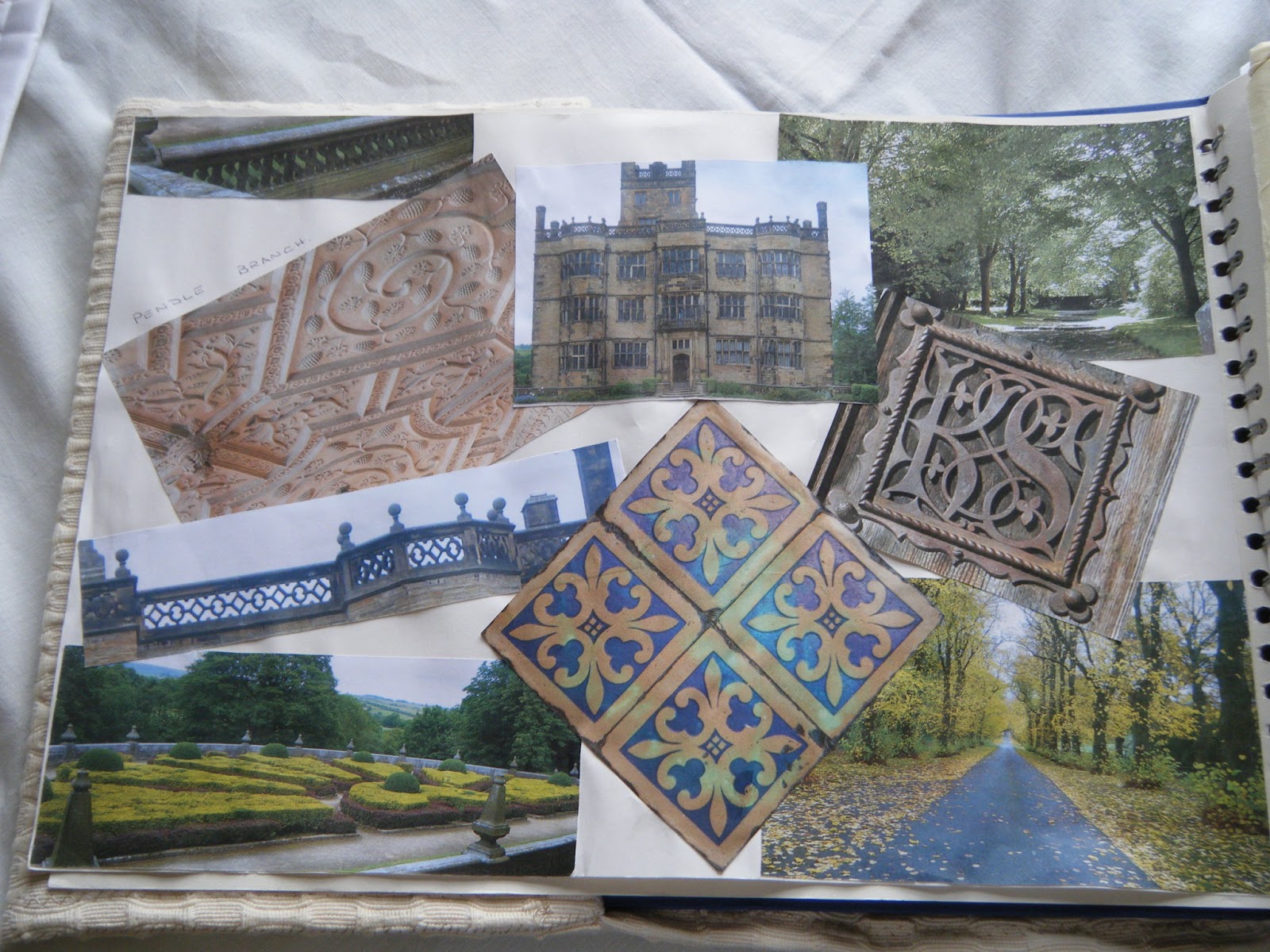
A challenge was set by the  previous Chair Person of the North West Region of the Embroiderers Guild, for each branch to produce a double spread in an A3 sketchbook to represent their area.
The left hand page would show the inspiration for the work with the textile piece on the other. 
This is the cover of our North West Regional Travelling Book. Its is quite large  and full now and can be borrowed by each branch to enable their members to see the work of other groups.


Here are some of the pages that I snapped at the last Regional AGM.


Bolton 


Chelford


              Cheshire Borders and Chester 


Cumberland 


Glossop and District


Macclesfield


Not all branches put their name on the pages so I am assuming that these pages depicting Morecambe Bay are from the Lancaster Branch.

Lancaster


This pages showing Gawthorpe Hall near Padiham must be from the Pendle Branch.

Pendle


Preston


Rochdale


Warrington


I hope that you have enjoyed seeing these pages. Quite a bit of thought and much work went into making them. If you would like to see the pages close up and read the information on them, ask your Programme Secretary to organise a visit from 'The Book' or go to a Regional Day or Regional AGM to see it in person.