Thursday, 28 September 2017

A Little more Drawn Thread Work

After all the busy'ness'/business of the AGM, Subscriptions, Competitions and the essential tea and coffee break, of our last meeting at the Lytham St Annes Embroiderers Guild we finally settled down to a little stitching! 
This was the second part of our workshop in Drawn Thread Work, see the previous posts here and here.
It turned out to be a 'very little' so no photos of works in progress, am afraid but here are a couple of Samples of the new stitches we were learning, that our Tutor, the amazing Linda Bedford, had whizzed up for us beforehand. 
This is Interlaced Hemstitch that is worked on a section that had 8 threads withdrawn and the top and bottom was worked in Hemstitch over 2 threads (this is called Ladder Stitch).

 Working the top and bottom rows again in Hemstitch over 2 threads to prepare the edges, a Diamond Hemstitch is then worked in the centre over the threaded area that was left untouched. Shown in Orange thread, above.
Here is the same Diamond Hemstitch pattern worked in a dark navy thread, below.
 The Diamond Hemstitch was worked in the section you see below that has 4 weft threads removed, then count down 4 threads and remove 4 more weft threads. This leaves a section untouched in the middle on which to work the Diamond Hemstitch pattern.
 Coral Knots, above worked in pink thread, have had 10 weft threads withdrawn and the top and bottom areas were worked in purple flossed Hemstitch over 2 threads.
Four Sided Stitch shown on the top row of the sample in navy, below has been used to give a more decorative effect. The bottom row has been worked in Hemstitch over 4 threads also and this gives the coral knots a cross stitch effect in the centre.


Here is the completed Sample of Drawn Thread Work stitched by Linda. This is what we 'should' end up with if we follow the handouts.....


Top Row is the Hemstitch over 2 threads, or Ladder Stitch as it is also known when worked top and bottom rows either side of the withdrawn threads. This is commonly used to start off the pattern.
Second Row is Hemstitch over 4 threads.
Third Row Zig Zag Hemstitch.
Fourth Row the Interlaced Hemstitch.
Fifth Row Diamond Hemstitch.
Last Row the Coral Knots with Four Sided Stitch on the top and Hemstitch over 4 thread on the bottom.

We were very grateful to have Linda on hand to help especially as half of the members were beginners having missed the first workshop in August due to holidays etc.
A big Thank You to Linda for all her hard work in teaching our two work shops and for providing us with fabric, thread, work sheets and samples. 
We now have another technique in our repertoire! 
If you would like to learn about Drawn Thread Work or other types of embroidery, do come along and join us on the 3rd Wednesday of every month. Address on the right hand side bar. You will be made very welcome.

More Purple!

As promised in the last post showcasing the entries in the Novice category of the Trudi Goodenough competition this year with the theme The Colour Purple, here are the entries submitted for the more experienced stitchers.
Lovely hand embroidered Lilac Blossoms, below, with a crewel work flavour to the stitches. Very pretty.

 Next up is a splendid creature of myth and magic - a fabulous velvet Purple Dragon with sparkling silver plumes of smoke coming from his nostrils. The background fabric is fitting too as it gives the impression that he/she is in a misty lagoon or swamp.

 Canvas work Diamonds in purple and aqua with silver highlights, above. What a fantastic colour scheme and very neatly stitched.
Lime greens, yellows and purples, below, make up this lovely little cushion based around 4 lines. Needle woven flower petals give the piece a very professional look. The fabric has been hand dyed.
 A Soutache Pendant, below, looks striking in purple braid embellished with beads.
 You can read a little about the Soutache technique of braid making, in this post here
Detail of central design in close up, below.
 More striking Purple Canvas Work, below.  The one Red Square in the top right of the design gives the piece interest (apologies for the flash in the photo it was impossible to get a clear picture). You can still see the effort that has gone into the stitching and appreciate the workmanship. Love the touch of red.

Lastly, we come to the Winning Entry, below. 
This is a lovely display of Stump Work Pansies complete with a bee and small butterfly. Extremely nifty fingers stitched these delicate petals one by one with Long and Short Stitch to give shades of colour.


 And here is our Winner of the Trudi Goodenough Cup this year; Diane holding the Cup and her entry, in the photograph below. Well Done Diane!

Well thats all for now. All the work was well executed and we appreciated the work that went into each of them. Thank you to all our entrants in each category of the competition.
Which piece caught your eye and perhaps gave you the inspiration to start something in Purple of your own?
Till the next time - Happy 'Purple' Stitching!

Saturday, 19 August 2017

A Lesson in Drawn Thread Work

At the Lytham St Annes meeting a couple of days ago, we had an enjoyable workshop on Drawn Thread Work taught by our long-time member; Linda Bedford.
Here is a small section of a larger piece of Drawn Thread Work that you may remember seeing here in the Exhibition Posts.

Linda always goes to a lot of trouble making sure that not only are there plenty of samples to pass around and scrutinize to see what we are trying to achieve (and aspire to!) but that we are equipped with extremely helpful handouts detailing each step as well as a little history on the technique. Fabulous when writing up a blog post :-) Thank you Linda.
For those of you that are not familiar with the Drawn Thread Work, it is a counted technique usually worked on evenweave fabric (examples in this post); traditionally Linen and is one of the oldest forms of open weave embroidery. 
Threads are removed or 'drawn' out before being stitched together around the remaining threads to form a pattern utilizing the gaps.
There are many varieties and patterns that have been developed over the centuries and just as many uses for an item decorated in Drawn Thread work, such as Altar Cloths embroidered by nuns in 13th century Germany. During the Renaissance it was used as a 'fake' lace which during that time being hand made was expensive and slow to produce.
Drawn Thread work has also been used in garments and household linens - tray cloths being a popular use today. 
Whilst categorised as 'White Work' contemporary pieces do use coloured thread as it is much easier to see, especially if you are new to the technique.
This is a sample of what we were learning in our first Drawn Thread Work Lesson.
 Top row shows Hemstitch over 2 threads, middle row is Hemstitch over 4 threads and the third row stitched is called Zig-Zag Hemstitch.
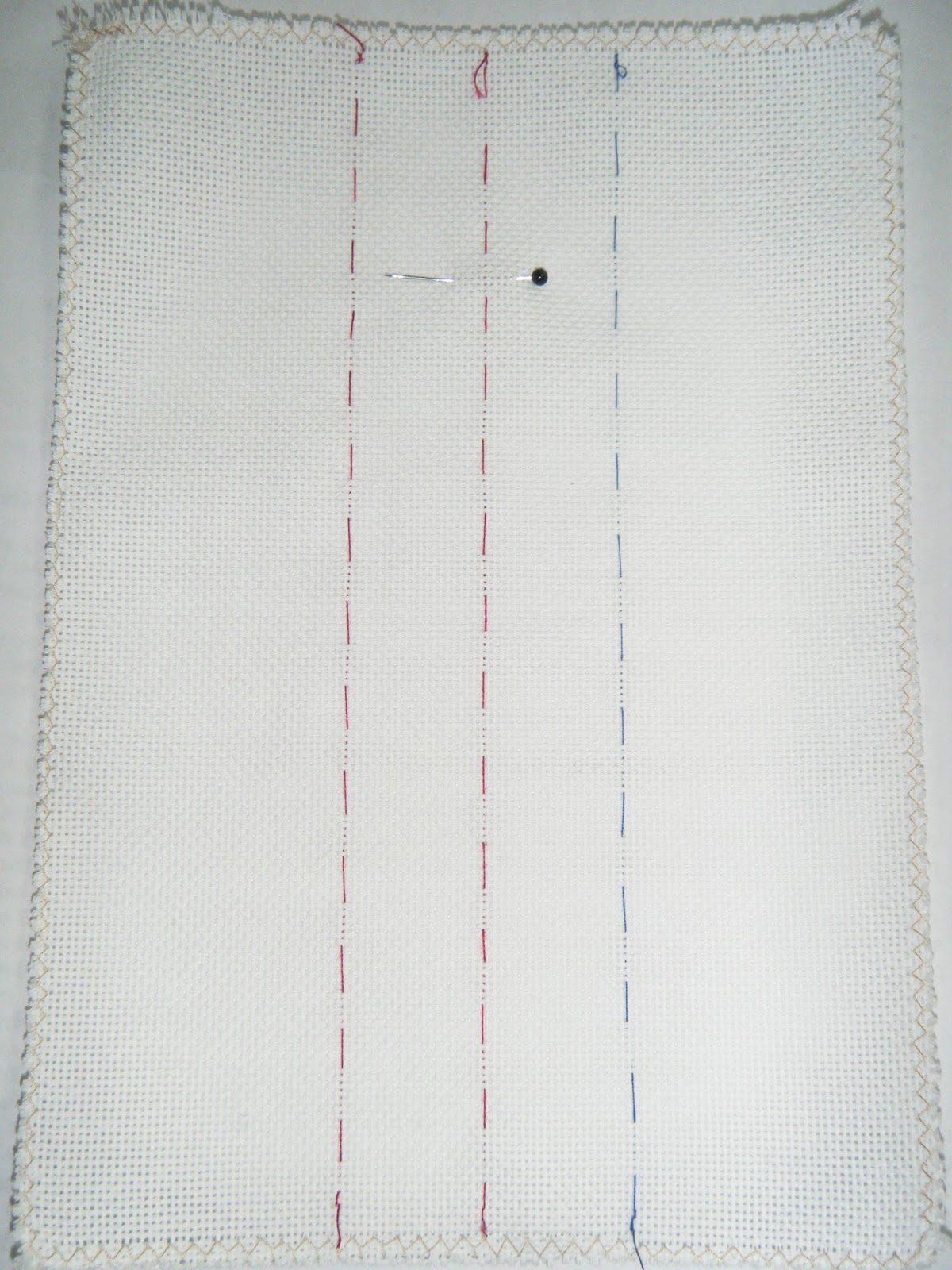
As you can see in the sample above, the fabric - we were using a Zweigart 18 count Davosa cotton fabric in Antique White with a coloured Perle no 5 thread; needs to be prepared by first marking 
the central vertical with a running stitch line using ordinary thread and a tapestry needle as the blunt point makes it easier to push the needle through the holes in the fabric.


Then counting 20 threads to the left of the central line - a pin is a great help in making sure you don't lose your place; we stitched another vertical line and repeated this again 20 threads to the right of the central line. We ended up with 3 vertical marked lines.
Linda went to great lengths to explain how to do this and which lines were Warp (vertical) and which Weft (horizontal - or 'West to East' is a good way to remember). She made a HUGE sample piece, seen below, to help us to see how to with draw the Weft threads by cutting 2 weft threads on the centre line about 2 inches from the top (as shown by the pin in photo above) then taking the first out about 3 cm past the left line and taking to the back so that the second thread could be woven into the space beyond the line on the first.
Some Teachers Go to Great Lengths to Teach their Pupils!
It sounds complicated in text but in reality was really quite easy to do once you had seen how its done or had Linda's excellent handouts that were complete with diagrams to show the method of stitching. 
The trick to the weaving part was having a tapestry needle that had an eye large enough to fit the weft thread but small enough to weave it into the top line without it being obvious. Some tapestry needles are too small and others quite large so find a 'middle' size one (you'll know once you use it).
Another method for fastening the loose threads is to sew with Satin Stitch but that method is for another day, another post, maybe.
I won't even try to explain the stitching as a diagram is best but you make a waste knot and then come up two threads below the first space - then  it was a case of following the diagrams for each different stitch to make the patterns.
 Depending how many warp threads you take the needle around and under and where - you can offset them by doing two threads beginning and end of row - makes the patterns differ.
Here are some of our works in progress below.

The sewing thread needs to be pulled firmly to make the Warp/vertical threads stay together.
Once one row is finished, weave you sewing thread under to fasten off and then start the other row in same way with a waste knot.
Above, in green is Hemstitch over 2 threads.
In our lesson we did not get up to Hemstitch over 4 threads, or Zig- Zag where the 2nd row is begun and ended with working over 2 threads and the rest of row over 4, but these are easy enough once you have gained confidence - more in next post.


 A very big Thank You to Linda Bedord for all her hard work in preparing and teaching us this lovely technique with her usual patience and expertise. We were quite a handful during the counting and withdrawing thread phase, I can tell you..... however, practise makes perfect so they say - and it is true, we went home and reread our handouts and got down to stitching and found out Oh Joy! it really is quite easy! (just like Linda had promised) once the counting, drawing out and weaving in is done it stitches up FAST. Yippee! - now we are all ready, homework done and happily anticipating our second lesson in September. 
Until then you can feast your eyes on some of Linda's beautiful Drawn Thread Works of Art coming up in the next post. 

An Elephant on Parade

Do you remember this huge Elmer that appeared at the recent Exhibition of work by Lytham St Annes Embroiderers Guild?

He was a stitching activity that visitors could take part in by stitching and decorating one of his coloured squares. At the end of our 2 1/2 day exhibition Elmer was not quite finished, needing a few more squares completing before he had his new suit.
Here are his completed leg sections.
  A completed back leg, above, and front legs, below; with a bit of body :-)


 Now Elmer has had his ear attached, above, and below,  a very colourful and also now decorated - Elmer. How happy he looks.
Someone also penned a sweet little story about Elmer's New Suit, describing how he met a few ladies sat stitching and eating cake (of course!) on a Sewing Day and expressed an interest in having a new embroidered suit made. The ladies being members of the Lytham St Annes Embroiderers Guild rose to the challenge and very soon Elmer was admiring his new reflection in a lake. Was that Fairhaven Lake, I wonder? 
Loving the lake detail as Elmer does seem to jaunt about in the woods quite often and there is usually a lake. It really made me smile. 
How about you? Are you a fan of Elmer too? Come and see him at our meetings in Ansdell. Details on the right side bar.


Elmer now has an ear, below. Bet he is very glad about that...


Elmer in all this colourful glory.