Monday, 23 July 2018

Got it Covered! - an Aqua Coloured Competition

Each April the Lytham St Annes Embroiderers Guild hold the
 M Scott-Priestly Competition with a theme set by our Chairman. 
Having acquired (as we all seem to do without even trying!) a roll of rather lurid fluorescent aqua or maybe its turquoise? fabric, she set us the task of using a piece of it, in or for  something that could be defined as having Got It Covered. 
So here are some of the inventive results.

A delightful little 'Treasure Chest' to keep bits and bobs was covered in co-ordinating colours of aqua, pink and lime green which nicely set off the sumptuous box top. See detail of top, below.
Gorgeous Button Hole stitches and French Knots surround sequins and 'glass' effect sparkles. So pretty!


Above, white is a good choice of fabric as a border to calm down the brightness of the aqua centre piece.
Detail of the stitches, below, show Fly stitch,  French Knots and beads to decorate the patterns on the fabric. Looks very comfortable but too nice to squash by sitting on it!

Have used the flash here below to show the texture of the paper that has been used to make a little book that holds several 'Stitch Studies' using the fabric in different ways. This is the Front Cover.


The six pages, above and below. look like they were fun to do. Just adding stitches and beads whilst enjoying using the fabric in imaginative ways. Great idea.


Here is a lovely little white square box with a rather grand flower sitting on top of the lid.
I hope that our stitcher forgives me, but I cannot tell if the gold stitching around each petal is done by hand or machine as it is so very neat. It must have taken hours of careful work, either way. 
Never realised it before but white really does compliment and give a luxurious look to aqua/turquoise, doesn't it? It can be a strange colour to wear but we all seem to love it :-)

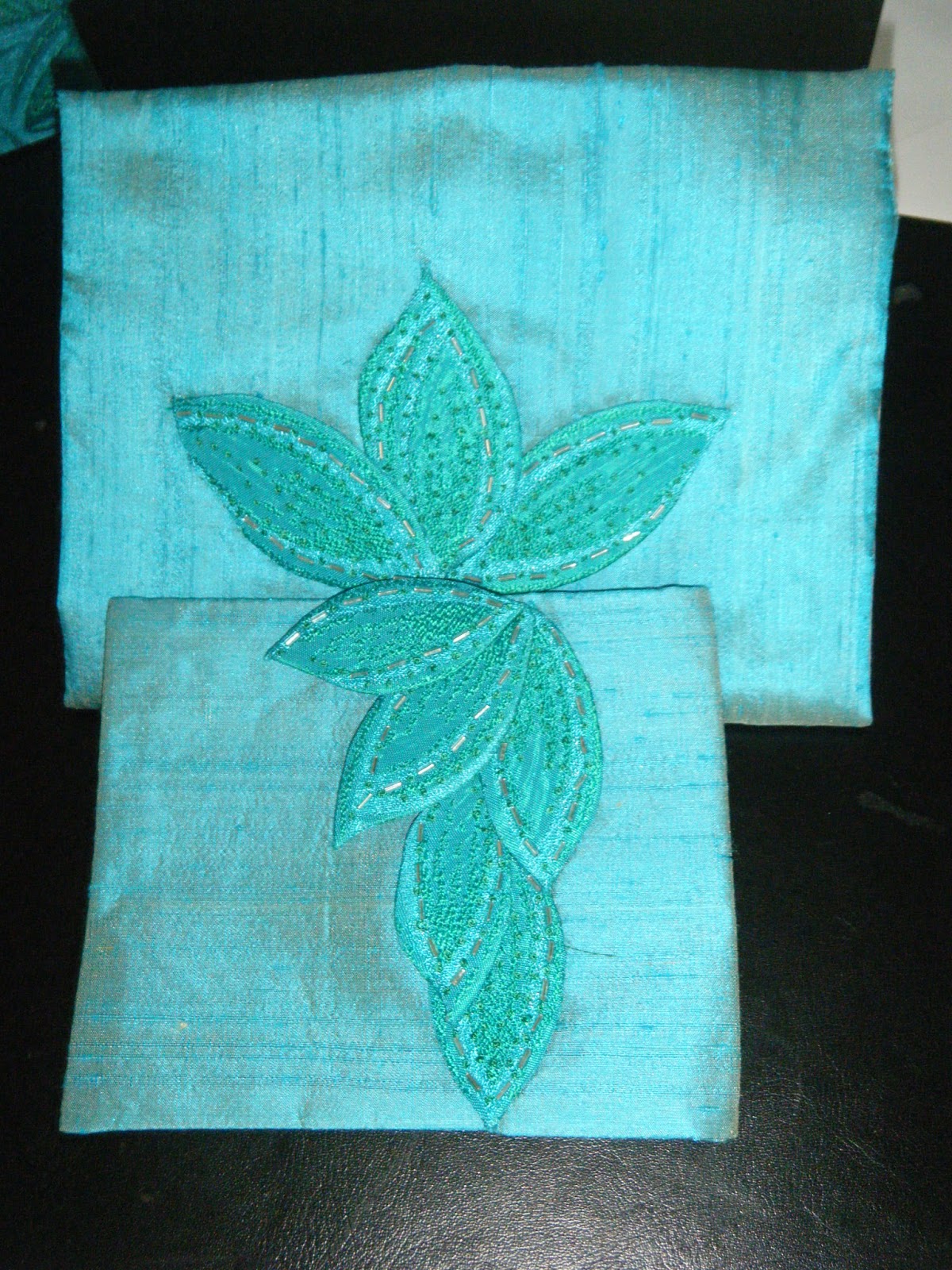
This is a very nice way to use the fabric; as a sort of Mock Fastener to a Clutch Bags or Make-up Bags, made in a matching coloured silk fabric. Lovely.


Last up on this post, but not least is another Note book cover very neatly and simply stitched using Chain stitch around French Knot flowers. This will make someone happy whilst writing using this note book :-)


Everyone seemed to enjoy this challenge as there were so many entries. Look out for the rest coming up soon in the next post.
Thank you to all our stitchers for making such good use of this unusual fabric and allowing photographs of their work.

Contemporary Cutwork from the Folio

The last post showcased some the more traditional pieces of  Cutwork from the Embroiderers Guild Folios. Here are a few modern and colourful ways of using Cutwork. Enjoy!


Correct me if I am wrong but I believe this is Hardanger? using yellow, blue and red threads, above. It is very striking stitched in vivid colour.


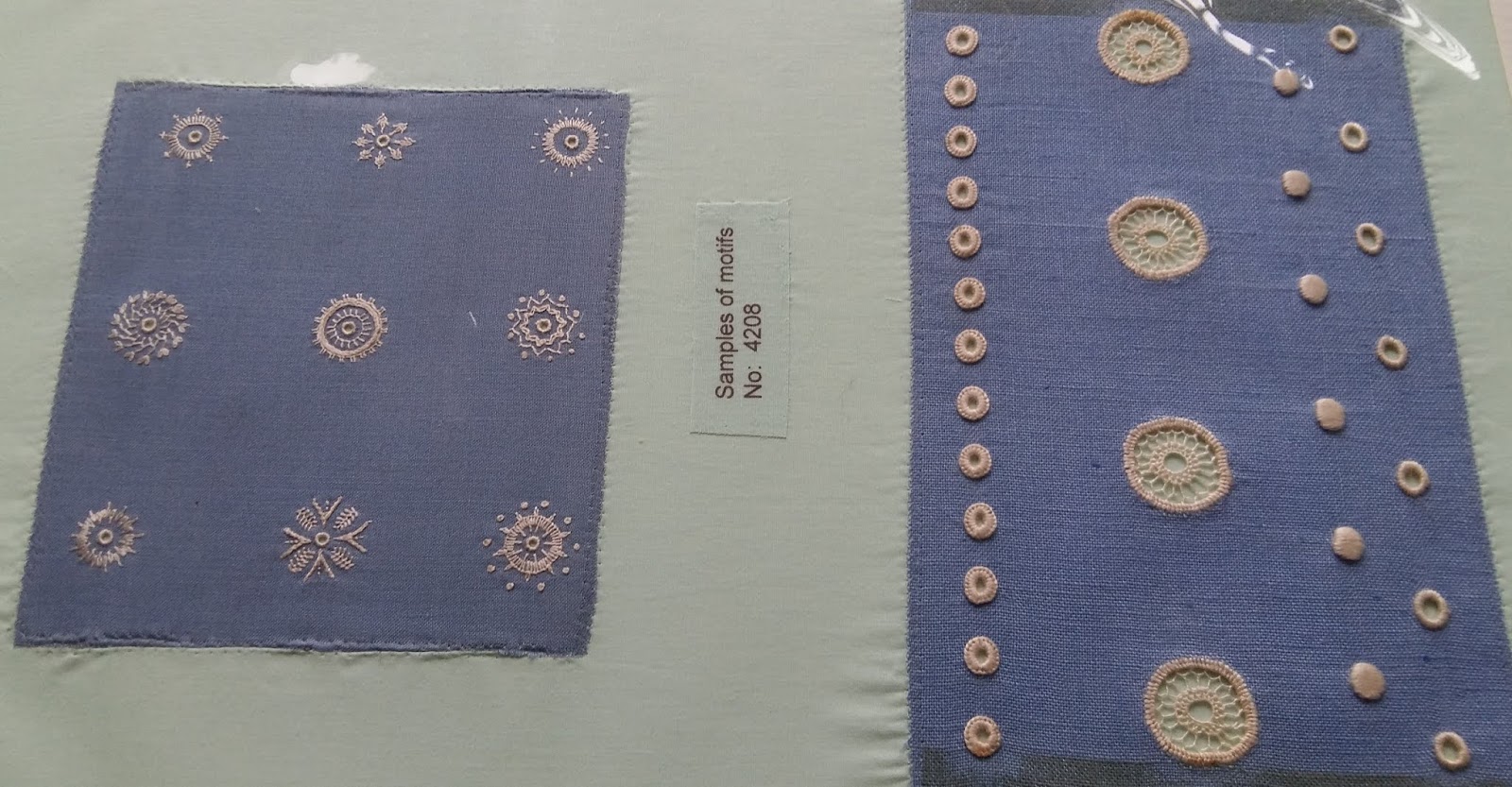
A sampler worked on blue linen with ideas showing how the design could be used in practical ways around the home. This was another of my favourite pieces.
Below, a Hedebo sampler on white stitched by a self-taught student named Stephanie Louch. She also used the Hedebo technique more freely to stitch the wonderful jellyfish, starfish and fishes under the sea.


Threads Drawn from a loosely woven cloth can be stitched over by hand, as above, or freely by machine (drop the feed dogs first) and can make wonderful textural pieces like this. It is especially great for making a tree design.

Similar to Reverse Applique this free machined Cutwork piece on red suede made by Elaine Wilson has coloured pieces of silk remnants showing through. This is achieved by layering fabric and sewing the design before carefully cutting away different layers to reveal the various colours of fabric underneath.


In 1986 a stitcher by the name of Rebecca strong made these lovely delicate pieces of Cutwork using a sewing machine and metallic thread.
Below, beautiful Whipped Eyelets on blue fabric sit protected by their plastic cover. Another favourite.


Here is a very modern piece, not sure of the date but it was made by a Miss Manning. It looks stunning mounted on pink card, was that her intention, I wonder, or did someone curating the pieces at the Embroiderers Guild HQ in Bucks, have this idea?

Below, the last photo of our post, are free machined pieces donated by the East Kent Guild. These are on Organdie, the cutwork being made with a soldering iron. 
The green sample on the right was inspired by a design on an early English Tile at Canterbury.


Well, that's all from the Folios for now. Maybe our branch will borrow another in the future, but until then why not get cutting and stitching yourself or look out for our May post which will be reporting on the workshop we had creating Cutwork Butterflies. 
As always Happy stitching!


A Folio of Cutwork

The April meeting of the Lytham St Annes was a little unusual as it was an opportunity to view by slide and 'in person' part of the Embroiderers Guild Collection.
Folios are made up of various samples of embroidery based on one technique that have been preserved by mounting and placing in strong plastic folders to protect them. This enables the work to be loaned out for a limited time period to Embroiderers Guild Branches around the country.
Our branch borrowed the Cutwork Folio and our member speaker spent a great deal of time carefully photographing each piece and presenting them to us via a slide show that accompanied a talk that she had written also.

When this idea was first stared, folio collections were called Model Boxes with the samples and a description of the stitch, technique, influence and/or name of the embroiderer accompanying each sample.


Here is a Baby's Bonnet from Flanders made around 1550 to 1600.
Cutwork is a form of embroidery where threads or part of the fabric is removed before being surrounded by stitches or connection bars of thread. It is a forerunner of Needle Made Lace and is an umbrella term for a number of different techniques that include Broidery Anglaise, Renaissance Embroidery, Richelieu, Venetian Embroidery, Reticella and Hardanger.


This is a long gown for a baby, perhaps a Christening Robe and it dates from 1850 - 1870.

Originally, Cutwork was used in the sacramental robes and grave cloths of Saints and appeared around the 13th Century.
Between the 13th and 16th Century it was principally Nuns that used this technique to make robes for Priests but during the 15th early'lace' masking flourished in convents, Court and homes of the nobility.
The Court of Elizabeth I favoured it for collars and ruffs on their gowns and robes.
In the 19th Century with the advent of the sewing machine this type of stitching could be made faster and by the 20th Century machine embroidery became established.

Here are lovely examples of Cutwork Mats, the one above left came from Norway and was donated by a Lady Blake. Above right the mat with a Cut work Cross design came from Sicily.
Below, the Circular mat from the 1920s and donated by a 
Miss Brekke; is an example of  Buttonhole and Padded Satin Stitches.
Various names have been used to describe Cutwork through the ages. In France it was known as Point Coupe, Punto Tagliato in Italy and Opus Seis Sum in Germany. There is also Danish Hedebo, Mexican Open Work, Czech Cut Work, Russian Touchon Lace of the Ukraine and Drawn and Cut work from Spain and Sicily.


This was one of my favourite parts of the Folio, above, worked by a Mrs Isabel del Strather ( or Strother?) is shows a well thought out design for a Hardanger piece based on the underside of an African Violet leaf. The technique is called Knoster Blocks and worked in perle thread.

More Hardanger above and below, sorry I did write some dates but do not appear to have them for these.


Above, these are Napkin rings using a variety of cutwork techniques and include needlework and cross stitch. 

Below, is the South Lakeland Sampler made by 62 stitchers over a period of 5 years at the Ruskin Lace School during classes spanning 1972 to 1977 taught by Elizabeth Prickett who also designed the piece. It is made on linen with cutwork and needle lace and is in storage at the Victoria and Albert Museum, London.
Here is a link to the V+A page regarding this piece.


Many thanks to our member SD for her hard work putting the talk and slide show together for us. Just writing this post has taken so much time so I do appreciate all her work, especially sending me these photographs to use in the Blog. Thank you!
In the next post will be examples of more contemporary and colourful Cutwork pieces. Be sure to have a look.


Friday, 20 July 2018

The 100 Hearts Project


To commemorate the 100th Anniversary of the ending of 
World War I, members of the Embroiderers Guild were invited to make a heart which will be on display in locations around the country.
Principal exhibitions to display the hearts are the Knitting and Stitching Shows at London and Harrogate this year and the NEC, Birmingham in 2019.

Here are two hearts lovingly made by members of Lytham St Annes branch.


This red heart decorated with goldwork, was made by our member K in honour of her grandfather who fought in the Great War.
The writing on the top reads Royal Fusiliers.


The goldwork Flags and the Thistle represent their emblems. Very detailed work.


The lettering reads 1916 Somme and his name  
James Henry Hesse number 2466. 

The stripe signifies that he was wounded in battle. Wounded ex-service men had to wear these stripes to prevent them from being harassed by some who would go around giving a white feather to any man whom they deemed as cowards for not being in active service! 

This very brave man was a Signaller who put up the wires used for communication during WWI. It was a very dangerous job and this led to him being shot in the back and lying in No Mans Land for over 24 hours. He was found on 16 July 1916 and sent to the Casualty Clearing Station 12 miles away but the shrapnel stayed and bothered him for the rest of his life and would flare up with red patches on his skin.
The casualty report stated 'several gun shrapnel in back' and his records managed to survive when the Warehouse in London were they were kept was destroyed during the Blitz. 
These are known as the Burnt Records.

This blue heart, below, was stitched by our member L to honour her grandfather's brother who was not known to her until researching her family tree.

W. A. Hutchings fought bravely in the famous series of battles in Arras during WW1.

He sadly died on 23 April 1917. It is a pity that we do not know more about him.
I find the motif of the soldier at the graveside of a fallen hero so  poignant. The silhouette also shows the recognisable army uniform from this time period which changed distinctly in the next World War.


Detail above, shows poppies growing in among barbed wire.


This picture shows the many beads which were carefully stitched around the heart.
Thank you to our two members for sharing their work and stories with us.
This has been the saddest post that I have ever written for our blog. Usually its all oohs and aahs about the stitching but this really touched me emotionally. There is more to the story about what happened to James Henry Hesse after the Great War, that brought tears to my eyes.
Many of us had relatives that fought and lived through the 2nd World War and know the sacrifices they made but so often never spoke of - so I am sure that you will find the WW1 hearts and the meaning of their motifs equally as touching.
So all that remains for me to say regarding all fallen hero and heroines; is


At the going down of the sun and in the morning.
We will remember them.