Sunday, 30 July 2017

Machine Embroidery

In this last post documenting the Exhibition of work by the Lytham St Annes Embroiderers Guild, we have a selection of machine embroidery.
This table had a Japanese theme to it (the other half of the table held the display of  Tama bags made from Kimono fabric - read about these here). 
The Kimono wearing ladies on the cushions have been designed on the laptop painstakingly drawing with a mouse and then stitched on a specialist embroidery machine to make these exquisitely decorated soft furnishings below. 

Here are the Japanese Ladies in close up, above and below. 
Notice the traditional footwear.
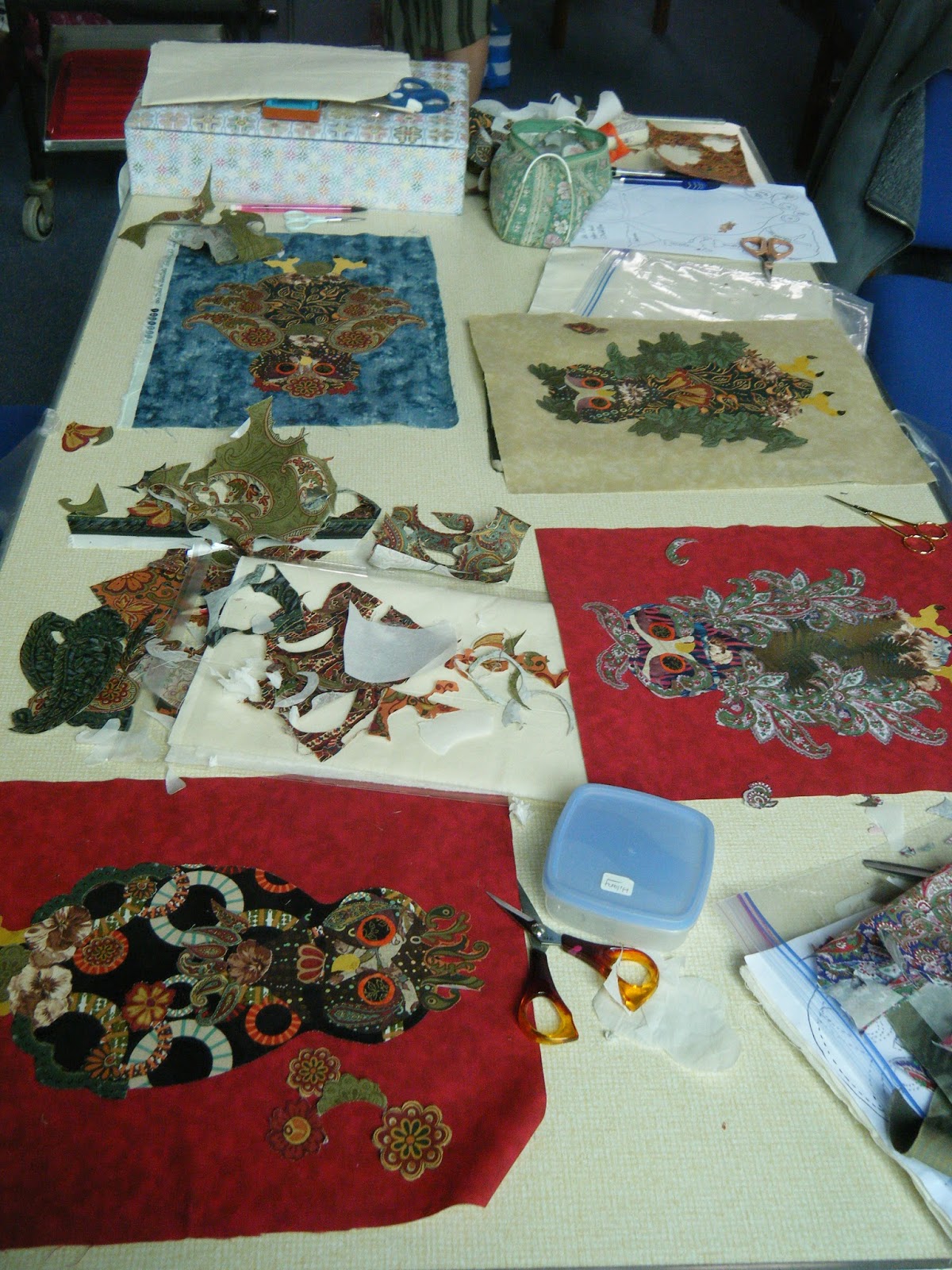
Our designer went to a lot of trouble to explain the process to make these embroideries on her Brother Super Galaxie 3000 embroidery machine as you can see from the stitched samples and information cards in the first photo of this post.
Whilst the embroidery itself was done in 15 minutes it took 2 hours at the programming, laying and editing stages if you are not using a commercial pattern.
You will need to import an image and make changes, or draw free-hand from scratch using a stylus making sure that all the lines are joined up so that when you select the colour and stitches to fill in there is not a bleed through when it is transferred to the embroidery machine for stitching.
The result is a very professional finish. This was how the bib was made in the previous post.
A twin needle was used to make the square quilting pattern on both cushions.
Love the orange silk Kimono design above!
Below, we have the Oust House. This has been free-machined, which means no patterns or computer programming but you do need concentration and a good eye as well as steady hands and a lot of practise.
Very nice detailing on the brickwork and roof and fabulous floral and green touches growing up the walls of the oust house. See the little attic door in the roof?

Another little door in the trunk of this tree, above. Do fairies or elves live here? Lovely textural stitching make up the grass and greenery.
Below, a beautiful Poppy Bag fit for an evening out.

More free-machining on this interestingly shaped Triangular Bag above, you can just see the beaded flower detail on the Tama bag behind it (see link to see the other Tama bags).
Free-machining on this Nuno Felted bag above, and also free machine quilting on the Owl wall hanging below.
This is Woody, the 'green man' owl. Isn't he lovely? There were a few owls submitted in various stages but Woody was the first quilted and finished (and the best outcome in editing..) To see the other Owls in the making, click herehere and here. The Owls are from a design by Lizzie Wall the Tutor who took the Day School in the links. 


Lastly, we have a couple of free-machine embroidered and embellished book covers. The Terracotta Triangles book cover, above, has couched gold braid that has been free-machine couched using zig-zag and a loose lower tension. Also loving the charms on the ribbon closure.
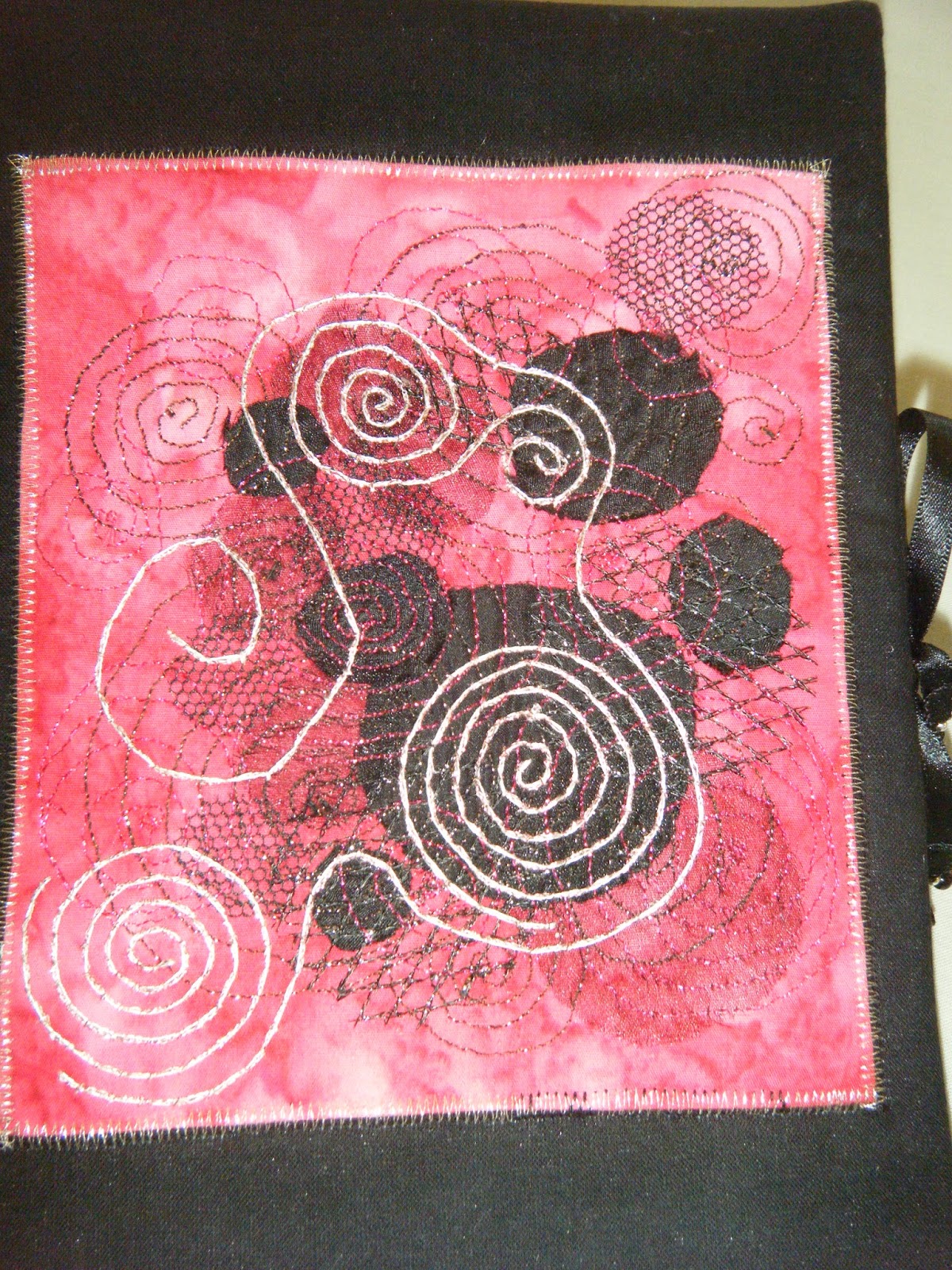
Not sure what the correct colour of the next Spiral Book Cover should be. The reddish pink/coral colour above, or the terracotta below? Both look great but the flash has altered the colour of one. What do you think? Which is your fave?
Whisper - think it may be this one above as the stitching style seems to be that of the maker of the first Terracotta Triangles book cover.

Well, thats all the photos from the Exhibition that came out well enough to post.
We do hope that you enjoyed viewing them. Our stitchers and makers certainly put in a great deal of time and effort not to mention those who gave their time to catalogue, set up, steward, take down, tidy up and all the other jobs and organisation that go into a 3 day Embroidery Exhibition, on top of the making.
Grateful thanks to you all for making everything such a success.

If you can't wait for our next exhibition in 2019 consider coming along to our monthly meetings and join us. You will be very welcome. Address on the right hand sidebar.

Tuesday, 16 May 2017

Quilt Class for Owls

These are the last (but not least) of the Raw Edge Applique Owls made on the Day School by members of the Lytham St Annes Embroiderers Guild Group.
Read previous Posts here and here.
 Lovely Owl with green paisley wings. Notice how the paisley shapes differ in size becoming larger further up the body; and such sweet floral ears. 
Leaves make up the ears  and wings to great effect on the Owl, below. Flowers have been used to create feathery effects at the throat and legs although a little higher up on this owls legs perhaps denoting his or her age and stature.
More fabric pieces awaiting placement on the left.


This is a real Cutie Pie, above, with jade green leaves making lovely wings and a thistle embellishment adding chest decoration. The clam shell fabric mentioned in this post, makes for very good leg feathers or 'fancy pants'. Really sweet.
 This fabulously colourful Owl, above, could have been made by Kaffe Fasset himself - wonderfully bohemian.
Below, our paisley feathered friend touting a fascinator on her head is perched on a branch awaiting her date. Ooh La La...

 Here is another 'Pretty Young Thing' above. Pretty pink elements and the butterflies and large yellow flower make for an adorable lil' owl.
So you see there is no need to stay within the safe confines of what is traditionally 'owl like'. Why not add uniqueness to those feathers with flowers and butterflies and a bit of bling. 
We did not have time to start sewing on the day - everyone was far too busy quietly snipping and cutting and preening feathers. Not much 'tweeting' or 'twittering' went on as everyone was fully immersed and absorbed by the activity. This cutting and sticking thing is very therapeutic :-)
If you would like to have a go yourself contact Lizzie Wall here.
Here is the final line up of all the Owls at the end of the day. A fine flock am sure you will agree :-)
All that is needed now is a piece of backing fabric topped with some wadding an inch or so larger than the top layer with the owl on and then a little quilting.
Lower the feed dogs on your sewing machine and attach a Darning foot (aka a Hopper foot) so that you can free-machine around the various elements of your owl design. Sew closely to each feather or piece in either matching or co-ordinating thread, following the outline of each shape. 
To quilt the background sew lines close together around the body echoing the shape. This lends itself to using a variegated thread colour as there are many colours in the owl itself and a variegated thread prevents having one background colour fighting for attention with your main subject. 
Add bling by using metallic threads or hand sew beads or tiny buttons or sparkly cut out shapes. Can't wait to see the finished results.
Thank you to all our members for allowing photos of their lovely owls and to Lizzie Wall for tutoring us in a very enjoyable workshop.

Owls on Parade

Here are more Owls strutting their stuff and flourishing their feathers at the Lytham St Annes Day School with Lizzie Wall on the previous Saturday (read post here).
We hope that you enjoy their little parade and perhaps gain an insight into the many different effects you can create using fabrics that you may not normally have chosen.
What a pretty Blue Owl, above. Using very fine pointed embroidery scissors will help you cut out fanciful shapes and even cut and remove small pieces to create 'air flow' throughout the feathers. The same blue fabric has been used on the whole owl but care has been taken to select different parts of the pattern for the each body part. The orange leaves are a nice touch to make a little pop of colour in contrast to the blue.
Below, pink floral elements make for lovely wings and cutting long pointy pieces at the end give an arm and hand like appearance to the wings giving this Little Owl character.

This blue bubble type fabric may not at first be the obvious choice for feathers, but as you can see from the image of the lovely owl above, blue 'bubbles' work very well in this context.
Here is this Wise Owl again, below, in all his/her majestic glory. Adding a little green onto the beak also works very well.
A green clam shell type fabric, shown below, also becomes 'feathery' in appearance when added to the chest of this sweet little Green themed Owl below (this fabric was also used as leg feathers on an owl in this post).

Here is the owl again, showing green chest feathers to full effect and the addition of green lightning shapes on the lower body add a unique but still owl like touch.


A flamboyant Blue Owl, above, looks lovely with the pink flower fascinator and pink leg feathers. Perhaps a little more is needed?
Yes, that it..... a few more blue feathers on the body and we are good to go!
Thank you to Lizzie and all our members for displaying their work here for us.
One last 'Owly' post is coming up. 

Day School for Owls

No its not a new class at Hogwarts :-) this was the latest Day School at the Lytham St Annes Embroiderers Guild; making Applique Owls with Lizzie Wall.
Lizzie came to speak to us last year regarding her work making quilts, wall hangings and other items using the Raw Edge Applique method. See the posts about this here, here, here and also here.
By using a paper backed fusible product, such as HeatnBond; you can cut the shape precisely as you want it without adding on a seam allowance or turning it under.

 One of the tables at 'Owl' Day School, above, showing work in progress.


With this method you fuse the product to the back of your fabric, fussy cut out your shape ie feathers and wings, beaks and tails or as with the Owl above;  cut out flowers make pretty feathery bits around the legs and chest. This adds a softer touch to the very modern pattern on the body.
Paisley is great for feathers and plumes as with the Green Owl in the pic below, waiting for his paisley feathers to be added on.


Peel off the paper backing and then fuse in place ( take care to place a piece of baking parchment over the fabric to be fused to protect your iron from the glue).
This method is a very popular way to make Art Quilts and allows you to build up layers very quickly before doing any sewing. It also makes it much easier to make complicated looking designs as shown by the wonderful Owls created on the day by our members attending the class.
Here as some examples below.

Cut out a fancy swirl to make a plume on the head, above, or as the lady making this owl informed me "its a girl so its wearing a fascinator". She will also be adding some 'bling' once she starts sewing and quilting the various elements.
The owl wings are made up of various fabric pieces that are layered up. Don't you just love the brown flowers that make up the feathers on the legs? They look like fancy pantaloons or bloomers. Cracks me up :-)
A sweet Chick, below, with jade leaves decorating the head and chest, with floral paisley wings. Notice the pink legs. So Cute. This also shows how fabric choice can be used to determine gender and the age of the owl or animal. 


The male owls seem to be darker in colour with  the more obvious feminine colours being used for the 'girls'. Babies seem to be made up of paler fabrics and have less detail, giving them an 'innocent' wide eyed look. Or perhaps I am just being fanciful? What do you think?
  
 This owl on a blue floral background, above, seems to be a little older than the jade coloured owlet previously, but still seems to be a youngster. It could be either a he or a she. The blue body is a nice touch as are the shoulder feathers giving the appearance of a collar on a cape....... Now these owls really are taking on personalities and even have their own style of dress and fashion :-) 
 The rather dapper owl, above, on the red background, is looking very regal. Perhaps, he or she is a member of Owl Royalty? Loving the fern feathers on the chest.
Below, this Dame, knows a thing or two, and is all dolled up for a night on the town in a gorgeous blue feather boa, or maybe its a Mayoral Chain of Office? Perhaps I have been watching too much of a certain Warner Bros film.....
I do hope that no owls were offended by their descriptions. They really are beauties, though aren't they? 
Thank you to Lizzie Wall for tutoring us on the day, click here to see some of her own Owls.
More of the Lytham St Annes Owls are making their debuts in the next two posts. Stay tuned.